The five fingers of Chinese poetry

In a February blog post, Yao Dunlin compared five well-known contemporary Chinese poets to fingers:

  • Hai Zi (海子), the middle finger: The middle finger is the longest of the five, and Hai Zi was unquestionably the most poetically talented of these five individuals.
  • Yu Jian (于坚), the thumb: The thumb is short and thick, just like Yu Jian. But it is also the most powerful.
  • Yi Sha (伊沙), the little finger:  The little finger is the weakest of the five, just like Yi Sha has the least skilled qualifications of these five people. However, the little finger is often used for disdain, satire, mockery, and defiance. It is the crankiest, most stubborn, most dislikable, and showiest.
  • Xi Chuan (西川), the nameless finger: The nameless finger is the one that wears the ring, and without a doubt it is the most dignified of the five for fitting reasons. Yet the name “nameless” itself involves thought, philosophy, depth, and reason.
  • Bei Dao (北岛), the index finger: The index finger is the hero that “points to the mountains and rivers” and “sets people afire with words.” A hero ought to have a hero’s indomitability. This Bei Dao most certainly possesses. He is a unequivocally a genuine hero.

Via Yi Sha’s blog, which tends to repost anything that mentions his name, however briefly.

Chinese physicist tilts at Einstein

xk090308spacetime

Only 65 yuan for the secrets to the universe

The Changsha Evening Newspaper recently devoted a full-page article to one Tan Shusheng (谭暑生), a scientist at the National University of Defense Technology who is challenging special relativity with his own theory of space-time. Tan’s monograph, From Special Relativity to Standard Space-Time Theory (从狭义相对论到标准时空论), was supposed to have been published several years ago, lists its publication date as July 2008, but seems to have been delayed until just this January.

“Chief reporter” Chen Guozhong wrote up the article, which goes into detail about the acclaim Tan has been given by his colleagues in the field but which doesn’t really explain what all the fuss is about. However, it concludes by saying “the rationality, simplicity, and internal logical consistency of the fundamental propositions of standard spacetime are all superior to those of special relativity.”

In a more enlightening interview conducted in 2007 by the Science and Technology Daily, Tan explained that his theory is an improvement on the Lorentz aether theory, which postulates an absolute frame of reference and a non-constant speed of light. Tan says that his contributions were to work out the spacetime coordinate transformations and formulate the whole thing into a standard spacetime theory, which includes standard spacetime electrodynamics.

He’s quite confident in his accomplishment:

I can state with certainty that if the theory of standard spacetime had been published at the beginning of the Twentieth Century, humanity would have accepted it over special relativity. If you carefully read my book you will discover that this is not some wild claim but is in fact the truth.

The 570,000-character work starts off with a thorough account of historical approaches to spacetime and the natural world, from ancient China’s five elements, to various understandings of aether, and finally to special relativity, before explaining his superior theoretical framework.

CNBeta’s daily summary snidely remarked that Tan’s theories would be “proprietary intellectual property rights.” Chinese particle physics will at last be free of the tyranny of foreign licensing fees.

I speak braille

Life as a blind masseur

Life as a blind masseur

Bi Feiyu’s Tuina (推拿, a traditional form of theraputic massage) won acclaim and awards in 2008 for its portrayal of the lives of blind masseurs in Nanjing.

Tuina is a slow-moving, character-driven novel in which nothing much happens in the first third beyond introductions and background information, but once you get used to the pace of the author’s plain prose, it’s a hard book to put down. Each of the dozen or so masseurs has a story to tell about being blind in China today. Some are touching love stories, others are tragedies in which personal desires go unfulfilled in a society that has certain expectations of people with physical disabilities, and still others are harshly cynical about a culture that is blind to the interests of people who cannot see.

One of the bleakest, and funniest, stories is about Du Hong, a late arrival to the massage business who started out as a piano prodigy. After discovering she had a talent for music, her teacher set her straight about the way the world works:

Du Hong, you don’t know, you don’t understand! You’re blind, so where’s the future in becoming a singer? You’re not deaf, and you’re not mute, so where will you get by singing? Where’s the special education? Ah, how can you understand? In special education you’ve got to find something difficult, do something you’re unable to do. Like a deaf-mute singing, or like a physically-disabled person dancing, or like a mentally-challenged person inventing something. Each of these shows off the school and the miracle of education. In short, a disabled person only has the power to touch people’s hearts, to move a generation, and to shake society when she endures incredible hardship and puts herself through the fire to do something that is difficult or even possible for her to do, and does it well. What’s so special about a blind person like you singing? All you have to do is open your mouth. But playing the piano is hard. The hardest thing for a blind person is to play – the – piano. Understand? [62]

Du Hong eventually quits her studies after learning first-hand exactly why her playing touches people’s hearts. At a benefit concert, she chokes and turns in an awful performance, yet the crowd gives her a standing ovation. Afterward, the host interviews her for the cameras:

And then with a flourish she asked the big question: “And why did Du Hong come to perform for you all today?” Yes, why? Du Hong  herself wanted to hear the answer. A hush fell over the gallery. The host answered her own question in words that would bring a tear to your eye: “Poor Du Hong” came “to repay of society — all of you grandfathers and grandmothers, all of you aunts and uncles, all of you older brothers and sisters, all of you younger sisters and brothers — for the love you have shown her!” The violin music that had been playing in the background swelled up underneath the host’s words and echoed through the hall and throughout every corner of “society.” [64]

Language plays a noticeable role in the novel. Speech registers separate blind from sighted, although it’s not made clear exactly what that means. For example, Doc Wang, a masseur who returned to Nanjing from a high-paying job catering to foreign clients in Shenzhen when the economic downturn at the turn of the century evaporated his business and torpedoed his stock investments, often describes his old friend Sha Fuming as “talking like a sighted person,” and occasionally the narrator will observe that a statement that would have seemed entirely normal coming out of the mouth of someone who could see was surprising to hear from a blind person.

Written language also shows up briefly. The back story of Sha Fuming, who co-founded the massage business where most of the book is set, involves an episode in which he skips class to visit a bar with a sighted woman who introduces herself by writing her name on his hand with a piece of ice. He has to tell her, “I…can’t read.”

Sha Fuming was telling the truth. He spoke Chinese, but it wasn’t genuine Chinese, it was a special language. More precisely, it was braille. He had never spent any time learning Chinese characters, even though he knew the Three Hundred Tang Poems by heart. [123]

Chinese Braille is printed twice in the book: once when Sha writes his name in droplets of water for the woman (“That’s…so cool!” she says), and once on the cover. It’s mentioned a few other times, but Bi Feiyu isn’t really concerned with the mechanics of surviving as a blind person in Chinese society so much as the feelings that are created by the experience.

Search the Hong Kong Film Archive

Hibiscus Town results

search results

The Hong Kong Film Archive’s search tool is an invaluable resource when you’re faced with the task of translating movie titles that may not be well-known enough (or involve enough Internet-savvy westerners) to be listed in the Internet Movie Database. It’s also great for finding out the standard English names of tiny production companies and major production staff, as well as Chinese translations of foreign movie titles.

After spending hours combing the Internet for obscure movie titles and common transliterations of the names of particular crew members for use in director bios and other festival materials, this will be the first place I’ll look from now on. It’s not perfect, but it’s a great starting place.

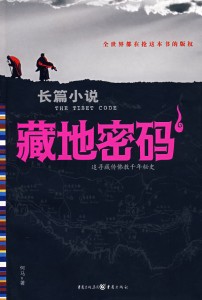
Code switching in The Tibet Code

The whole world wanted the rights to this book

The whole world wanted the rights

The story that drives the five volumes (so far) of The Tibet Code (藏地密码) revolves around a grand quest for the wonders of Tibet’s legendary past: the treasures of a lost temple, the race of mystics who guarded it, and a massive, ferocious variety of Tibetan Mastiff, known in the historical records as the Purple Qilin.

Although the mythology in Volume I is dispensed with a regularity that keeps the story moving at a decent pace, the plot is really nothing more than a wild goose chase: after traipsing back and forth across Tibet in search of clues that won’t be revealed until later volumes, our heroes assemble their elite adventure team and, in the final pages of the book, are finally prepared for the true quest to begin. Unfortunately, judging from the table of contents for Volume II, that appears to be a trip to the Amazon, a plot twist for which Volume I laid absolutely no groundwork.

Mandarin is the dominant language of conversation for the characters in The Tibet Code, and when they switch to Tibetan it’s noted in the narration but not marked in their speech, with one interesting exception. Early on, Tibetan mastiff breeder Chomo Jampa is telling his mentor, professor Fang Xin, about the legend of the Purple Qilin. He begins by translating the texts into Mandarin. This reads perfectly well, but his pauses frustrate the professor, who asks him to continue in Tibetan.

So he switches to Tibetan (which for some reason the author chooses to describe as “fluent,” even though that should go without saying for an ethnic Tibetan born and raised in the region). Tibetan conversations in the rest of the book are rendered in straightforward Mandarin, but in this case, the character is reciting an ancient text, presumably in classical Tibetan of some sort. To convey this, the author uses classical Chinese for this portion:

大藏王朗达姆,好狩猎,喜逐狼荒原,即位,宣布废佛,迫僧脱袍狩猎,灭佛首,天道不容。

The emperor Langdarma loved hunting and delighted in chasing wolves across the wilderness. When he ascended the throne he declared Buddhism abolished, dismissed the monks and forced them to go hunting, destroyed images, and did not submit to the will of heaven.

The Tibet Code was originally published online and appears to actually have been edited somewhat before appearing in print, at least judging by the polished and expanded classical Chinese passages. I’m not all that eager to read any more of it again, however.