The short reviews in this post were written in mid-2007. All three books were fairly ephemeral. I can remember some of the major plot points of Amy Cheung’s story, and I have a vivid memory of my mounting frustration at Wei Hui’s preposterous characters and ridiculous situations. I have no recollection whatsoever of the Han Han novel.
The Glorious Day by Han Han
韩寒,《光荣日》
 Han Han’s latest novel was billed by promoter Lu Jinbo as “magical realism,” but it’s really just a loosely-connected series of moleitau vignettes. Like his previous novel, The Ideal City (一座城池), this book features a group of friends who have to find a way to support themselves in the remote town in which their journey unexpectedly deposits them. They get housing provided by a school in desperate need of teachers, but spend most of their time trying to make enough money to purchase the necessary supplies for a secret project that Mai Damai, the leader of the group, has cooked up. They have comical run-ins with local law-enforcement, take up with loose women, and exercise a corrupting influence on the young people who have been placed in their care. Han Han’s iconoclastic sensibility is as much in evidence here as in his earlier novels.
However, where City‘s action mostly involved just the three main characters, the shorter Day has to follow the activities of this larger group of classmates, few of whom receive any significant character development. And while City had at least some semblance of plot surrounding its extended joke sequences, this book provides very little to hold together the set pieces, which, in classic Hong Kong comedy tradition, are hit-or-miss. A scene of absurd violence at the start of the book is handled quite well, but there’s an unsettling misogynistic streak to this novel that hasn’t been present in Han’s earlier works. Still, it’s only the first volume, so we can hope that Han Han will tie everything together in the conclusion (if he ever gets around to writing it).
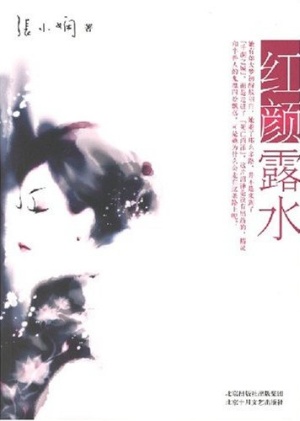
Hongyan Lushui by Amy Siu-han Cheung
张小娴,《红颜露水》
 Last summer when I was in Hong Kong getting my visa taken care of, I picked up a copy of this book where it was on display atop the best-seller rack. I’d heard of Amy Cheung before (she was in the news a while back when she announced plans to switch gears and work on a series of vampire-themed horror novels), but I hadn’t ever read any of her work. The mainland edition was published in May.
The title Hongyan Lushui could be translated as something like “Dewy Complexion” if it weren’t taken from the name of the protagonist, Xing Lu (邢露). She’s a barista who left a job at a luxury jewelry store for the freedom that comes with working in a small coffee shop, but still smarts from the indignity of her situation: her family once had money and social standing. We follow Xing Lu’s romantic history through some initial heartbreaks until she hits it off with an impoverished artist, only to inexplicably break off the relationship and torpedo his career.
For about two-thirds of the novel I grew increasingly frustrated with the plot and the idiotic decisions of the main characters, kept interested only by a peculiar little man who turned up from time to time to frighten Xing Lu (I had the notion that the story was moving in a heavily psychological direction, and that this man was a hallucination, or perhaps something supernatural. I was wrong). The story’s conclusion eventually cleared up all of the mysteries and redeemed the characters themselves, whose motives were not as random as they initially appeared. Still, I felt cheated by the way the author had deliberately withheld background information for no reason apart from manufacturing suspense.
In any event, it’s a quick read — between the wait at the airport and the flight back to Beijing I was able to finish it off.
Doggy Dad by Wei Hui
卫慧,《狗爸爸》
 A girl rejects her long-term boyfriend’s proposal for reasons she cannot explain and then goes in search of him when he suddenly leaves town. Oh, and she’s accompanied by her late father who has come back to earth as a dog.
Good stories have been written about talking dogs. This is not one of them. Wei Hui is the author of Shanghai Baby, a novel that became a sensation when it was banned for its frank sexual content. Wei’s latest book cuts out the sex, leaving the brand-name dropping and English-language asides feeling a little out of place within a simplistic story of a woman coming to terms with commitment.
The author has described her book un-ironically as “New Age,” and I suppose it’s not unfair to call it a supernatural parable of self-actualization. But it’s not one that we can actually appreciate. Our heroine’s impossibly trusting and generous nature inspires sympathy and understanding in everyone around her. Even con-artists reform themselves when she helps them realize that their profession is unethical. Practically the only purpose of her father the dog (Wei Hui’s publisher flubbed the English title on the cover by not calling the book The Dogfather) is to boost his daughter’s self-esteem by telling her that all of the problems in her life are someone else’s fault.
And that’s basically how the story wraps up. Questions are answered and conflict is resolved when the supporting characters awaken to the error of their ways and make their apologies.
Still, this won’t be the worst book you’ll read all year — you’re going to listen to my advice and not read it at all.